HIFIMAN launches HE6 WiFi planar headphone in China at ¥3,999 (about US$600)
The open-back planar streams over WiFi, takes LDAC and USB audio, and puts a HYMALAYA Mini DAC on each channel. It weighs 399g.
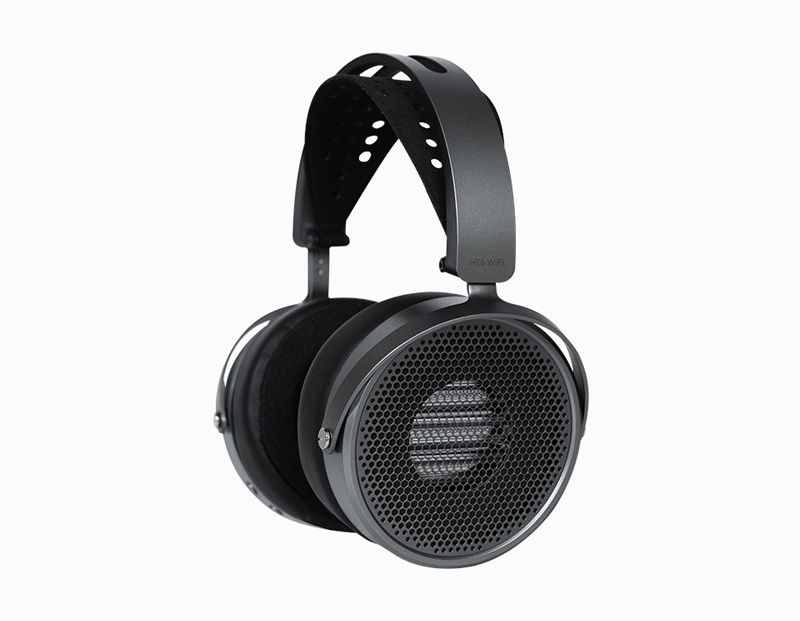
HIFIMAN launched the HE6 WiFi in China on 29 October at ¥3,999 (about US$600). It’s an open-back planar headphone with a WiFi streamer, a DAC for each channel and a headphone amp built in. A music app on a phone or tablet sends the stream over WiFi, and the headphone decodes and amplifies it itself. It also takes Bluetooth up to LDAC and USB audio over USB-C, and runs for 7 hours on WiFi or 23 hours on Bluetooth.
It isn’t the wired HE6 Remastered, a ¥12,800 limited reissue from May. HIFIMAN files the HE6 WiFi as mid-range, below the flagship HE1000 WiFi. Its China product page and user manual carry the full spec sheet. HIFIMAN hasn’t announced it outside China yet.
HIFIMAN pitches it as its Serenade WiFi desktop streamer and DAC/amp shrunk into an earcup. HIFIMAN’s manual and product page put one HYMALAYA Mini, HIFIMAN’s in-house DAC chip, on each channel. They sit on a ring-shaped 93 × 98mm board that also carries a fully differential headphone amp with a buffered analogue volume control chip, a multi-core CPU with DDR4 and eMMC storage, the WiFi module and a Qualcomm dual-mode Bluetooth module. The driver uses HIFIMAN’s second-generation NEO Supernano diaphragm, which the company says is about 60% as thick as the first, with its Stealth Magnets and an enhanced magnet.
There are four ways to play:
- WiFi streaming from music apps. The product page lists QQ Music (HIFIMAN calls itself a QQ Music hardware partner), NetEase Cloud Music and Qobuz, and the headphone is Roon Ready.
- Bluetooth with SBC, aptX, aptX HD and LDAC. The microphone works only in this mode.
- USB audio over USB-C, which also charges the battery while it plays. USB-C is the only socket, so there’s no analogue input.
- HIFISTYLE, HIFIMAN’s own protocol, streams straight from its HM2000 player with no router. HIFIMAN says this bypasses Android’s audio processing.
HIFIMAN’s notes recommend a 5G network, and the FCC grant dated 16 October covers 5GHz WiFi. The notes also say mesh networks work, but moving between nodes can cause delays, stutters or dropouts, so a single router is the most stable choice.
HIFIMAN’s frequency response chart
HIFIMAN says the HE6 WiFi sounds close to the wired HE6 driven by a high-power amp, and its product page backs that up with a frequency response chart of both. It doesn’t say how or at what level they were measured, and the curves aren’t level-matched: the HE6 WiFi’s sits roughly 12dB higher. With that offset removed, the two curves are within a few dB of each other from about 100Hz to 8kHz. The HE6 WiFi has slightly more bass below 100Hz and a shallow dip around 300Hz.

Specs
From HIFIMAN’s manual unless noted.
| HE6 WiFi | |
|---|---|
| Type | Open-back, planar magnetic |
| DAC | HYMALAYA Mini, one per channel |
| Frequency response | 8Hz–65kHz |
| THD+N (DAC) | 0.0055% at −9dB, 1kHz |
| Channel separation | 110dB at 1kHz |
| Formats | PCM 44.1kHz–768kHz, 16/24/32-bit; native DSD64–DSD512 |
| Bluetooth codecs | SBC, aptX, aptX HD, LDAC |
| Socket | USB-C (charging and USB audio) |
| Battery | 3.7V, 1,500mAh (FCC filing) |
| Battery life | 7 hours on WiFi, 23 hours on Bluetooth |
| Charging time | 3–4 hours |
| Standby | More than 30 days |
| Weight | 399g |
| In the box | Headphones with pads fitted, USB cable |
Price and availability
China: ¥3,999 list, according to a Weibo review, a weekly Chinese headphone round-up and SMZDM, which also gives the 29 October launch date. HIFIMAN’s page links to Tmall and JD. The Weibo review puts the price at just over ¥3,500 (about US$525) after subsidies.
What isn’t known yet
- International price and release date. The FCC filing doesn’t confirm a US release.
- Amp output power and driver size.
- Whether HIFISTYLE will work with players other than the HM2000.
- Independent measurements.
Corrections
2 Nov 2026, 11:12 pm AEDT: This story was first labelled First in English. A post on Reddit's r/headphones had covered the launch in English about 16 hours earlier, so the label has been removed.
Sources
- HE6 WiFi user manual, HIFIMAN (Chinese PDF; spec sheet on PDF page 11)
- HE6 WiFi product page, HIFIMAN China
- HE6 WiFi product page spec image, HIFIMAN China (frequency response chart, internals, network notes)
- FCC ID 2BAQY-HE6WIFI: WiFi streaming tablet diaphragm headphones
- HIFIMAN HE6 WiFi发布 3500元级高性价比WiFi大耳
- 耳机周报 2026年第44周
- HE6 WiFi上市一周,双11前最常被问的6个问题一次说清
- 现场直击|昨天HIFIMAN三箭齐发 核心是自研HIFISTYLE协议革命
- HE1000 WiFi product page, HIFIMAN China
Spotted an error? Tell me what’s wrong. Fixes are logged on the corrections page.